Sorry about the late post! I've been in Orlando this weekend getting some teaching professional development in. Chris Crutcher was one of the best speakers; he's an author and a child therapist who writes about his patients and ends up being banned from schools everywhere because of bad language. Funny enough, many students who read his works end up truly finding themselves as people and connect with the book at an extremely emotional level. It got me thinking that tennis is very much an emotional struggle, and many kids go through competitive tennis still mustering up the courage to step out on the court, even though they cannot control their thoughts.
I was one of those players. My entire tennis career, I can say now, made me the person I am today, and taught me many things other experiences don't have the capability of doing, even school or education through books. I struggled with my mental approach to tennis throughout my career. I was a very thoughtful player, in the sense that I had too many thoughts in my head while playing, from "That was a pathetic shot, Katie," to "Yes, I won that point, now let's get it back to deuce because this is an important game." I tried to shut off my mind loads of times, but realized that this was my kryptonite. There were times where I had a perfect balance of thought that didn't drive me crazy. Then there were times that this balance would slip, and my thoughts would pile up in my head like water bubbles boiling when a kettle of water is on the stove, finally boiling over the pot, and exploding (quite literally) my mind, creating a self collapse that would snowball and snowball. Who's thinking about tennis when your mind is fighting with itself?
There were many things that worked, and many that didn't work to help me get over this mentality crisis. Some things would work sometimes and not others. Breathing helped here and there, but sometimes it wouldn't. A coach talking/yelling at me sometimes brought me back to normalcy, others it only accelerated the boiling water approaching the top of the kettle. I'd repeat the mantra in my head that my dad, and my one true coach, always told me: "Don't try too hard." This is what I repeat now as a coach myself to other players. I tell players that I've been where you've been. Racquet slamming on the ground in frustration are unacceptable to parents, but understandable for me. Not saying that it's not unacceptable, but sometimes it takes someone who's been there to explain and be there through the range of emotions tennis (or any sport for that matter) courses through your body.
This blog isn't for answers, it is for explanation. I can't tell you what to do to "fix" the way you approach the game of tennis, but I can tell you that I've been there, like many of the coaches at Seminole High Performance, and try and give you a tiny look into my brian and into my thoughts. I can tell you this; the mental aspect of tennis is a continuing process. There are professional tennis players that are ranked top ten that struggle sometimes with their approach to the game. This isn't something you figure out and then you're good. It's a never ending process of improvement, and sometime, failure. Some things that worked for me may make you worse on the court, and some things that didn't work for me may be your salvation.
If you stick through it and don't give up, you'll emerge on the other side a more knowledgable and mature person. I know understand why my mom always told me that sport is the game of life, and that you learn how to approach life and its pressures through the game of tennis. The sport mimics life. Whatever happens, dust yourself off and get back up. It will make you stronger when you find your ground. :)

Sunday, October 7, 2012

Friday, September 28, 2012
Ssttretcchingg
I know, clever stretching of the title stretching, huh?
For the tight-legged, wound-up tennis players out there, I know how you feel, I've been there before. I actually only stopped being stiff (especially my hamstrings) after I started doing yoga, which is amazing and I recommend it to all tennis players.
Yoga strengthens the muscle at the same time as you stretch it; it encourages the muscle to lengthen, creating mean lean machine-like muscle (I have awesome rhyming skills, don't you agree?). It also encourages proper breathing and relaxation, depending on the type of class you take. Certain classes, like yin yoga, focus on the lengthening and stretching of the muscles; a good class for tennis players with stiff legs and backs to help them loosen up without much focus on strengthening. However, the best yoga classes stretch and strengthen, and opposite from common belief, are quite a workout. There are several varieties of strengthening/stretching yoga, including but not limited to "turbo," "Ashtanga," and "Flow." Hot yoga is another great class you can go to, where the room is heated to a toasty 110 degrees. You'd want to be careful if you've never been in a sauna or steam room before because it does get a bit uncomfortable, but it also relaxes your muscles for a deeper stretch.
 Now that you know the classes I recommend, let's go through some poses that you can do on your own. Keep in mind these are the starter yoga poses, and you could always adjust to your preferences.
The Child's Pose: The basic yoga pose requires you to lay down on your mat with the objective of getting your butt to your heels, which takes some time and practice.
The next pose is called the cobra position, and this stretches out your abs. Make sure you keep your palms flat and stretch your neck upwards, with your nose tracing a line up to the ceiling slowly. For these poses, you want to be able to keep them for at least one minute each, preferably at least three minutes for a deep ligament stretch.

 To the right you will see a very common pose called the downward facing dog, or downward dog. This stretches both the lower back as well as calves. The goal is to get your heels all the way to the floor. Make sure your back is straight, your palms spread out at the outer corners of the mat, and that you aren't adding unnecessary pressure on your wrists. Keep your feet about a foot apart (Feet a foot! Lol! :)), and if you want to add more stretch, pulse your knees forward and back and walk it out to get a deeper stretch in your calves.
Fire log is a deeper, more advanced pose. While it looks simple, it's hard to get your foot on top of your opposite bent knee. There are several factors of this pose that you need to know. First of all, while the picture is "picture perfect," you may not be able to get your knee all the way down on the first try. It also is nice to have something to prompt you up underneath the knee that is closest to the ground. You can use a blanket, a pillow, or a yoga block. This stretch is fantastic for the hip flexor, a muscle notoriously stiff for tennis players, particularly boys. For a deeper stretch, lean forward into the foot that is above your opposite knee.

 A simpler stretch that helps both the hamstring and the hip flexor is the stretch to the right. Your goal is to work your chin towards your knee; eventually you'll be able to reach your forehead to your knee like the lady below. You want to be careful not to over stretch your hamstring by pushing yourself too hard the first times you start yoga stretches. Your first goal should be to touch your shoelaces with your fingers (or your toes if you're barefoot)!
 Another good hip flexor stretch is to the right. You are reaching your chest towards you bent knee, trying to keep your back straight as you do so. You can also reach up with your hands, clasping them together, creating a straight diagonal line that starts with your clasped hands and ends with your outstretched foot. This a similar type of stretch that also strengthens at the same time, and is one of the few varieties of warrior stretches.
The pigeon pose, seen below, is a great quad stretch. A variation of this pose that is more advanced is to lay your front leg down, leaning your right front leg towards your left wrist. That made no sense. :)
I'll try again. Laying down completely with your left leg straight behind you and your right leg bent at an angle with your heel facing towards the left wall, use one of your hands to pull your left leg up into pigeon pose with your right leg still on the floor. This allows for a deep hip stretch while still working on your quad.
The man on the right is in a deep quad stretch that I only recommend for more advanced and flexible players. Start with your knees at either end of your yoga mat, slowly sink backwards, using your hands to guide you gently to the ground. Everyone can try this, but most likely you won't get all the way down to the ground on your first try. Your goal would be to get down to your elbow prompting you up at first.


 The Warrior pose is a great strengthening pose which enables all leg muscles in both a stretch and a strengthening position where they are holding the rest of your body up. Keep this pose for at least forty five seconds, but start with thirty if you can't handle 45 right away. Doing this in front of the mirror is important so that you can keep your arms level and keep one foot pointed forward while the straight leg is pointing sideways.

For the tight-legged, wound-up tennis players out there, I know how you feel, I've been there before. I actually only stopped being stiff (especially my hamstrings) after I started doing yoga, which is amazing and I recommend it to all tennis players.
Yoga strengthens the muscle at the same time as you stretch it; it encourages the muscle to lengthen, creating mean lean machine-like muscle (I have awesome rhyming skills, don't you agree?). It also encourages proper breathing and relaxation, depending on the type of class you take. Certain classes, like yin yoga, focus on the lengthening and stretching of the muscles; a good class for tennis players with stiff legs and backs to help them loosen up without much focus on strengthening. However, the best yoga classes stretch and strengthen, and opposite from common belief, are quite a workout. There are several varieties of strengthening/stretching yoga, including but not limited to "turbo," "Ashtanga," and "Flow." Hot yoga is another great class you can go to, where the room is heated to a toasty 110 degrees. You'd want to be careful if you've never been in a sauna or steam room before because it does get a bit uncomfortable, but it also relaxes your muscles for a deeper stretch.
 Now that you know the classes I recommend, let's go through some poses that you can do on your own. Keep in mind these are the starter yoga poses, and you could always adjust to your preferences.
The Child's Pose: The basic yoga pose requires you to lay down on your mat with the objective of getting your butt to your heels, which takes some time and practice.
The next pose is called the cobra position, and this stretches out your abs. Make sure you keep your palms flat and stretch your neck upwards, with your nose tracing a line up to the ceiling slowly. For these poses, you want to be able to keep them for at least one minute each, preferably at least three minutes for a deep ligament stretch.
 To the right you will see a very common pose called the downward facing dog, or downward dog. This stretches both the lower back as well as calves. The goal is to get your heels all the way to the floor. Make sure your back is straight, your palms spread out at the outer corners of the mat, and that you aren't adding unnecessary pressure on your wrists. Keep your feet about a foot apart (Feet a foot! Lol! :)), and if you want to add more stretch, pulse your knees forward and back and walk it out to get a deeper stretch in your calves.
Fire log is a deeper, more advanced pose. While it looks simple, it's hard to get your foot on top of your opposite bent knee. There are several factors of this pose that you need to know. First of all, while the picture is "picture perfect," you may not be able to get your knee all the way down on the first try. It also is nice to have something to prompt you up underneath the knee that is closest to the ground. You can use a blanket, a pillow, or a yoga block. This stretch is fantastic for the hip flexor, a muscle notoriously stiff for tennis players, particularly boys. For a deeper stretch, lean forward into the foot that is above your opposite knee.
A simpler stretch that helps both the hamstring and the hip flexor is the stretch to the right. Your goal is to work your chin towards your knee; eventually you'll be able to reach your forehead to your knee like the lady below. You want to be careful not to over stretch your hamstring by pushing yourself too hard the first times you start yoga stretches. Your first goal should be to touch your shoelaces with your fingers (or your toes if you're barefoot)!The pigeon pose, seen below, is a great quad stretch. A variation of this pose that is more advanced is to lay your front leg down, leaning your right front leg towards your left wrist. That made no sense. :)
I'll try again. Laying down completely with your left leg straight behind you and your right leg bent at an angle with your heel facing towards the left wall, use one of your hands to pull your left leg up into pigeon pose with your right leg still on the floor. This allows for a deep hip stretch while still working on your quad.
The man on the right is in a deep quad stretch that I only recommend for more advanced and flexible players. Start with your knees at either end of your yoga mat, slowly sink backwards, using your hands to guide you gently to the ground. Everyone can try this, but most likely you won't get all the way down to the ground on your first try. Your goal would be to get down to your elbow prompting you up at first.
The Warrior pose is a great strengthening pose which enables all leg muscles in both a stretch and a strengthening position where they are holding the rest of your body up. Keep this pose for at least forty five seconds, but start with thirty if you can't handle 45 right away. Doing this in front of the mirror is important so that you can keep your arms level and keep one foot pointed forward while the straight leg is pointing sideways.
Finally, another hip flexor stretch that is very relaxing is below. This opens up your hip flexors and allows you to breathe deeply in and out, relaxing your body as your hips open up. Start with your heels touching a bit further out, but as you get more flexible and want a deeper stretch, move your heels closer and closer to your body
On that note, keep in mind that yoga is a practice that allows you to relax, stretch, and help out your tennis quite a bit. If you have any questions at all or want to know more, write a comment and suggest a new blog topic, or ask me a question about yoga (or anything!).
Namaste!
Friday, September 21, 2012
Injury Prevention
Ouch! The classic way of starting a blog on injury
prevention. That being said, I rarely meet a competitive tennis player that has
never, ever had something hurt. More than being sore- don’t be a baby. Tennis
players have the luxury of being one of the few sports that cause the most
self-inflicting damage. While we aren’t tackled by our opponents and don’t take
our gloves off in order to punch each other (I guess hockey would be a fairly
uncommon sport in Florida, my apologies), the wear and tear of our sport can do
some harm if precautions aren’t taken. Take, for example, the continuous impact
of the hard court surface and what it does to a player’s knees and shins. Or,
think of the probability of twisting an ankle when running in almost every
direction with short bursts of explosion and the necessity for a quick change
of direction that the sport requires. Then, take the grueling impact on
shoulders, elbows, and wrists that is required to swing a racquet, below and
above your head. Back, abs, and hips have some liability when overuse and a
slight move in the wrong direction can tweak those large muscles. Pretty much,
we’ve hit every single part of our body in tennis that can eventually succumb
to painful injury- because tennis is a year round sport, oftentimes tennis
players are seen playing through numerous injuries. Bad. Very, very bad.
But that doesn’t help, does it, just to say playing through
injuries is not a good idea. Once injured, RICE is the best option- rest, ice,
compression, elevation. Sometimes, especially when muscles spasm, warmth is
better than ice. Applying a heat pack to relax the muscle can be beneficial. If
the urge to play is so great that even an injury does not stop you, wrapping
the injury is an option. This prevents the limb from moving in its full range,
and adds compression that helps inflammation subside. That being said, you kind
of need to know what you are doing in order for the wrap to work. Just rolling
up your ankle in globs of athletic tape won’t do anything. If you don’t have an
onsite trainer (all tournaments have them), handy dandy Google can help you
with the wrap of your choice. Odds are, your coach will know how to wrap the
injury too. Other, more obscure ways of treating injuries include electric
stimulation (pads that adhere to your skin and send electric pulses to the area
to a) relax the muscle and b) send more blood flow to the area), grastin
(metallic stubby knife looking things that are used by a certified trainer to
enhance blood flow to the area- as a person whose stubborn injuries were
alleviated by this method, I am a huge perpetuator of this method, although it
is painful), and orthotics (again, as a person with weird flat feet, I can
attest to the benefits of custom orthotics that are placed into the sneaker to
lift or support the arch in the foot. This can even change your gait and
posture).
Contrary to many beliefs, stretching can sometimes do more
harm than good to an injured muscle. It’s one of the best ways to PREVENT injury,
but not a great idea to do with, say, a pulled muscle. A pulled muscle is
already, well, stretched. Spasms, however, do need to be stretched. Exercising
also doesn’t seem to be a viable solution for an injury, but can be
surprisingly helpful when injured. If, say, I pulled my quadriceps, I would
strengthen my hamstrings, the muscle that works in tandem with my quadriceps,
in physical therapy. Speaking of balance in muscle strength, keep in mind when
working out that any muscle workout you do has to be in balance with the muscle
that it works with. For example, while rock solid abs are both attractive and
beneficial for tennis, strengthening your abs without strengthening your back
muscle can be very dangerous- you are setting yourself up for a very bad strain
to your back. A weaker muscle that works in tandem with a stronger muscle is at
risk of injury constantly because the stronger muscle overworks the weaker one.
Another thing to keep in mind is that tennis players naturally gain strength in
certain areas, and so a gym workout should focus on those areas that need
improvement off the court. Some of these areas include pectoral muscles, which
are shortened by the strength in a tennis player’s shoulders, and hip flexors
and the groin muscle, both of which are often underdeveloped in a tennis player
compared to their quads and hamstrings (hamstrings, by the way, are often much
weaker in tennis players than their quads- at a much younger me point in time I
was able to lift 80 pounds with my quadriceps but only 40 with my hamstrings, a
worrisome difference).
Injuries aren’t any fun. That’s why you should be reading
this next section, which is on injury prevention. Injury prevention is the
unsung hero of tennis, and unfortunately is often left out of grueling
practices where it is most necessary. There are certain things that you can do
while you are playing that will help both your game and your fitness and injury
prevention. This is a very simple idea- the fitter you are, the better
protected you are from injury. A strong muscle will take longer to fatigue and
will stay under control for longer. It’s important too though not to overwork a
muscle, since this shortens the muscle instead of creating the long and lean
but strong desired effect. Other things to prevent injuries, in laundry list
style (digression in parentheses- why do they call it a laundry list? I’d think
it would be more of a grocery list, wouldn’t it? Anyways…):
·
Stretch (not for two seconds on each leg- at
least 20 minutes with each stretch lastly around 15 to 20 seconds at the least)
·
Yoga (aka a long stretch- it builds stamina
too!)
·
Keeping your center of gravity low (or, in
layman’s terms, bend your knees!)
·
Maintain correct technique on all shots
·
Ice tub (for overworked muscles and cramping)
·
Hydrate (dehydration in a dilapidating injury),
preferably with coconut water or Pedialyte (see my nutrition blog)
·
For the sake of your tennis game, your mental
state, and your physical well being, if something hurts even though you took
the necessary steps to help it (ice, compression, ect.), take a break. It’s better to take two days off after a pulled
muscle then playing through it and having to take 6 months off for a tear. I’ve
seen this happen to tennis players and I’ve had it happen to me as well. No
matter what you have to be true to yourself and your physical well being-
that’s more important than a tennis match will ever be.
And on that point, tootles until next time!
Saturday, September 15, 2012
Learning & Coaching
Every now and again I think of my role as a coach, and the role of a coach in general for the learner of tennis. Being a teacher in school, it's important for me to reflect on my practices, but seldom do I reflect on my experiences as a coach. Because coaches aren't perfect either.
I first look back at how wonderful a job my parents did as my coaches, through the tears and fights and sweat, that made me a champion, and that continues to make my mindset and work ethic stand out from amongst my peers in many aspects of my life. I think about the passion they have for tennis, and the passion they vicariously instilled in me.
I think about what I've done as a coach, the students that I've taught, the shots I've made better, and I realize it's so much more than a shot or the game of tennis, just like in the classroom it's so much more than a novel or a good poem.
So I've complied a list. You know I love lists. But this list isn't just for you, it's reminder for me also, a reminder for me that I coach for a reason bigger than myself, and I hope one day it'll be a reminder for others who are in charge of children's learning and growing, so that they will always come out as a positive role model in someone's life.
Here it is; the list. A coach:
1. inspires a child to play tennis.
2. motivates; it's always easy to motivate a good player or a well-behaved child. But it is the one who struggles and who may have outbursts that needs the most motivation.
3. teaches discipline and routine; the child learns what is expected of them and what consequences await them if they do not follow through. Many believe that this may be strict or unfair, but it reality it gives kids wanted structure.
4. says the right thing at the right time, even if that right thing is saying nothing at all.
5. is a good listener.
6. is a role model at all times.
7. supports not just the player, but also his or her family and support system, and helps steer that support system to be a positive influence in the player's game.
8. notices the little things, whether it be a new haircut or a child's deteriorating attitude.
9. just once throughout the day, makes the child smile, and reminds them that tennis isn't everything.
10. is positive the majority of the time, and only negative when absolutely necessary.
11. let's the little things go.
12. loves what they do.
I first look back at how wonderful a job my parents did as my coaches, through the tears and fights and sweat, that made me a champion, and that continues to make my mindset and work ethic stand out from amongst my peers in many aspects of my life. I think about the passion they have for tennis, and the passion they vicariously instilled in me.
I think about what I've done as a coach, the students that I've taught, the shots I've made better, and I realize it's so much more than a shot or the game of tennis, just like in the classroom it's so much more than a novel or a good poem.
So I've complied a list. You know I love lists. But this list isn't just for you, it's reminder for me also, a reminder for me that I coach for a reason bigger than myself, and I hope one day it'll be a reminder for others who are in charge of children's learning and growing, so that they will always come out as a positive role model in someone's life.
Here it is; the list. A coach:
1. inspires a child to play tennis.
2. motivates; it's always easy to motivate a good player or a well-behaved child. But it is the one who struggles and who may have outbursts that needs the most motivation.
3. teaches discipline and routine; the child learns what is expected of them and what consequences await them if they do not follow through. Many believe that this may be strict or unfair, but it reality it gives kids wanted structure.
4. says the right thing at the right time, even if that right thing is saying nothing at all.
5. is a good listener.
6. is a role model at all times.
7. supports not just the player, but also his or her family and support system, and helps steer that support system to be a positive influence in the player's game.
8. notices the little things, whether it be a new haircut or a child's deteriorating attitude.
9. just once throughout the day, makes the child smile, and reminds them that tennis isn't everything.
10. is positive the majority of the time, and only negative when absolutely necessary.
11. let's the little things go.
12. loves what they do.
Sunday, September 9, 2012
Doubles Blog
Hello world!
I know, I know, I'm a day late. Sorry! But I have a good excuse. I sat and graded 8th grade projects from 1 to 9 pm. Yeah, my brain was fried. Now it's unscrambled a bit! :)
Some doubs tips:
I know, I know, I'm a day late. Sorry! But I have a good excuse. I sat and graded 8th grade projects from 1 to 9 pm. Yeah, my brain was fried. Now it's unscrambled a bit! :)
Some doubs tips:
Your initial reaction when someone else is on your side of
the court is “Get off my side of the court, fool!” However, if you’re playing
doubles, this may turn slightly problematic if you kick your partner off the
court. Now you have to tie the hypothetical umbilical cord and remember that
without teamwork, you pretty much stink at doubles. Being aware of where your
partner is beneficial, say, if they decided to throw a short lob to the
opponent’s volleyer and your still at the net. Movement together is essential-
two volleys are scarier than one, and two people in the back allows for a
better grapple at defense. Yes, grapple is a not only an awesomely cool word,
but it also happens to be a fruit- a cross between a grape and an apple-
there’s your fun fact for today.
Back to grappling (even more awesome than grapple!) with
doubles. Let’s talk positions. I couldn’t tell you how many times I’ve seen
someone (usually girls, sorry) hugging the doubles alley, knees shaking from
fear. The partner in the back has to cover about 80% of the court- don’t worry,
your partner’s got that other 20% on a leash (Not so good metaphor/attempt at
anecdote)! Truth is, there is not only “holy” position in doubles when the
point is being played out- actually, it would be more honest to say that the
“holy” position would be none at all. The more you move at the net, the more
pressure the opponent feels to hit a better shot, and the higher the chance
that they will make a mistake or that you (the volleyer) poaches. Yes, like an
egg in boiling water. Or illegally hunting game (I guess that’s a bit better
than an egg). Never really
understood why they (tennis-terminology inventors) called it poaching, but
nevertheless…
Back to grappling (!) with the volleyer’s positioning.
Again, there is no set place to stand for the volleyer during the point, but
there are rules to help you make the most of doubles when your partner’s
serving or returning. When your partner’s serving and you’re at the net (and
you better be- don’t you dare go to the baseline, even if your partner’s serve
travels 2.7 mph), you should be smack in the middle of the box. I hope I don’t
have to tell you what box I’m talking about, partially because I’d feel silly
explaining (the little one?), and partially because you’re just plain silly
yourself for not knowing what I’m talking about. So there. Anyways- help your
partner choose where the serve is going- if out wide, be ready for the down the
line shot, and if body or T, be ready to poach (like an illegal hunter J). Encouragement is
always nice- no one wants to hear “Can you hit the ball harder than 2.7 mph?”
or “Your serve is frankly quite terrible.” You laugh, but there are people who
actually say those things.
The returner’s partner. So say you’re at the net and you’re
partner’s returning. It’s okay if you’re at the net, but if the opponent has a
good serve, and the opponent’s partner likes to poach, you’re shark bait (or
illegally hunted meat?). It’s okay to say back on the first serve to avoid that
situation, but if you have a partner who has an awesome return, you should be
standing a tad bit to the right and back of the middle of the box (the small
one). So, you should be about a step from the service line and to the right of
the middle of the box. This position does a couple of things- it puts pressure
on the server, and it puts pressure once the returner hits back to the server-
it allows for you to poach more easily as well. Try this position out in
practice- your partner should be comfortable with you standing there before you
try it out in a match, because you would potentially be in the trajectory of
the ball if your partner can miraculously angle the ball off of a serve. You’ll
be fine, don’t worry- you have to reassure your partner of that too. Calling
the return is also a good doubles tactic- knowing where the ball is going off
of the return can help you feel more comfortable at the net, especially if the
return is going down the line. Speaking of which, some coaches believe that
going down the line is taboo, but keeping your opponent honest (think illegal
hunter) is a good doubles tactic. That being said, there is a reason why it’s
considered taboo sometimes- it’s hard to hit and easy to react to once you
expect it. Once every game is plenty enough. As the returner, it’s important
that a high percentage of returns go crosscourt- this is a high-percentage play
and involves your partner at the net into the point more.
Say you’re the server- high percentage
first service is key. If you have to kick your first serve, do it. Kick serves,
by the way, are essential for doubles play. It allows you to have enough time
to get to the net for a serve and volley and is consistent yet aggressive. Make
sure you stand wider on the baseline and identify the weaker side early one. A
body serve cuts off any angle that the opponent can hit, so lots of body serves
can be used. Stay tuned for more “advanced” positions like the “I” formation
and the “stack” formation.
Remember, don’t be the person cowering in the corner of the court and letting
your partner do all the work for you- man up and make like an egg!
Friday, August 31, 2012
Core
Hey world!
Let's get straight into our new blog, working on abs!
Let's get straight into our new blog, working on abs!
I have never met someone who decides that they are okay with
being an oompa-loompa. Considering mass advertisements with flat abs and
good-looking bodies, the American mind has been warped by media and what the
body “should” look like. Athletes in particular are expected to have bodies
that fit to a T, or at least fit into a t (J).
Flat abs are particularly tied to how you eat- those late
night purges on snickers bars and Coke will probably not help you out much. Now
if you want to get abs like an athlete, diet is not enough. A strong core (abs
and back) is essential for tennis- without it, you’re simply not up to par with
your highest potential. So I’ll provide you with some
not-so-fun-but-necessary-and-helpful core exercises to tone your muscles,
sleeking them into the physique that is worthy of a magazine ad and aiding you
in your tennis game (best of both worlds-really!).
These exercises are not only ones you should be doing, but
they do target your lower abs, which is where the dreaded belly bulge settles
(more often on women then men- don’t get me started female/male comparisons,
obviously I’m a little biased).
1.) The
bicycle
The bicycle keeps all of your body moving,
but at the same time can isolate all of the muscles in the lower belly to
continually pump your legs back and forth. Keep your fingers on your temples
(otherwise you’ll start moving your neck and back, which defeats the whole
purpose) and move your elbow to your opposite knee. The pace is up to you-
you’ll feel the burn regardless, but a good starting point is 30 seconds on, 30
seconds off three times through.
2.) The
crabwalk
The crabwalk again keeps your body
moving, and works on your balance as well as your abs. This exercise gets all
of the abs working, including your upper abs that usually get toned quickly
through crunches and a lot of other simple abs exercises. Facing your belly
towards the sky, alternate touching your toes with your opposite hand while on
all fours.
3.) No-idea-what-to-call-this
AKA “Partner toe touches”
You know, explaining abs exercises
through words is actually quite tough- glad that there are players around to
torture with some extra abs routines and video at the same time. J This next one,
although it does say partner, can be done without one. If you do have a
partner, lie on the ground flat and grab your partner’s ankles. Your arms
should be straight up. Pick up your legs to your partner without bending your
knees- they should touch your feet to signal you to go down- NEVER touch the
ground in this exercise. To make it more intense, have your partner throw your
legs down instead of touching- this keeps your abs burning throughout the
entire exercise (burn, baby, burn). Without a partner, grab hold of something
that won’t fall on you (a railing, for example) and do the same thing.
4.) Scissor
kicks and up-downs
Very clever names, I know. Lie flat
on your back, hook your arms underneath yourself, and pulse your legs up and
down without touching the ground. Hence, up-downs. Keep going about 20 times,
and then switch to scissor kicks- same position, crossing your legs over each
other back and forth (sideways). About 20 times, then rest. And again.
When you’re doing abs, it’s
extremely important to complete back exercises as well- the most dangerous
thing (other than a good-looking front and a not-so-much backside) is to not
strengthen your back as much as you strengthen your back; this causes a
disbalance (yes, that’s a word in tennis lingo spell check!) that can end up in
an injury.
5.) Superman
It’s a bird, it’s a plane, it’s a
bunch of junior tennis players training their backs! Lie flat on your stomach,
stretch out your arms and legs, and lift your arms and legs simultaneously off
the ground, and come back down. Point your toes when you do this, and lift up
as high as you can. The more you wait up, the more your back works. About 40
will do.
6.) Alternating
superman
It’s a bird, it’s a plane, it’s a
bunch of junior tennis players that are attempting to coordinate the
alternating superman! Same thing as superman, but now you’re lifting your left
arm and right leg at the same time, then alternating to the right arm and left
leg. About 40 will do.
7.) Weighted
back lifts
Same position but your legs will
lay flat the entire way through this exercise. Grab something with a little
weight- if this is your first time doing this, do it with your racquet. Once
you get better and stronger, you can add 5 or even 10 pound weights to this
exercise. Place the weight behind your neck, holding onto it with your arms.
Lift your upper body with the weight. Do about 15 of these, then rest and do it
again.
8.) I’ve saved the best for last- the plank. The plank is
known to be the best ab exercise there is for abs and core strength. Fold your hands together, lean on your
elbows, and lift the rest of your body up. To make it harder, put your feet
together—to start off, keep them apart. Start off holding on and off for thirty
seconds, but if you can handle that just fine, do a minute on and off. You’ll
feel the burn.
Saturday, August 25, 2012
A week in pictures...preparing for the fall
Hey guys!
So I'm teaching all day on Fridays throughout the fall (8th grade Language Arts, in case you were curious) and will be attempting to post each Friday but otherwise you should expect a post on Saturday. Hence, today, we have a new post! Yay!
For Leon County Schools and most other schools in Tallahassee, you've completed your first week at school- congrats! Now its time to get into the flow of the fall, including coming to practice from 4:30-6:30 Monday through Wednesday and 3-5 on Thursday to work on your game at Seminole High Performance.
Its always nice to reminisce on the past times, and so we'll spend this blog reminiscing our summer camps!


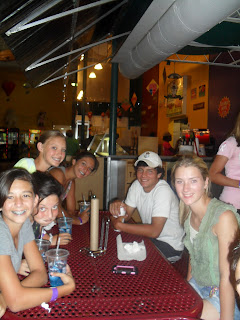
So I'm teaching all day on Fridays throughout the fall (8th grade Language Arts, in case you were curious) and will be attempting to post each Friday but otherwise you should expect a post on Saturday. Hence, today, we have a new post! Yay!
For Leon County Schools and most other schools in Tallahassee, you've completed your first week at school- congrats! Now its time to get into the flow of the fall, including coming to practice from 4:30-6:30 Monday through Wednesday and 3-5 on Thursday to work on your game at Seminole High Performance.
Its always nice to reminisce on the past times, and so we'll spend this blog reminiscing our summer camps!

The summer started off with our beginner quick start camps- the kids had a lot of fun learning how to play tennis. These three girls above were so adorable- they reminded us of the three girls from "Despicable Me!"

The quick start camps were held this year at the Holy Comforter school tennis courts. These three are taking a quick break in the shade to get ready to compete!

After each day, we reviewed what we learned that day. The kids went home tired and happy!

Week two of camps our coaches took the dorm campers to fun station. We had some fun with the kids go carting, playing mini golf, arcade games, and batting some baseballs in the batting cages. All Andres had to do for the kids to listen was to point at his shirt! :)

They were supposed to take a serious face picture, but they started laughing once I took it!

One of our coaches attempting the 70 mph batting cage. A swig and a miss! (I chickened out at the end and went into the 60 mph batting cage instead)

Week three of camps and we're with another group at fun station. They all got these drinks and ended up with blue tongues.

Some of our girls posing for a photo op!

Some more campers hanging out waiting for their pizza!
It always is nice to go back and think of all the fun times at camp. We'll see you soon for Seminole High Performance clinics and next year for more fun weeks of summer camp!
Till next Friday, tootles!
Subscribe to:
Posts (Atom)